Tanzania has an abundance of renewable resources that can be used to produce energy. Tanzania has an estimated 3,800MW of economic hydropower potential. Out of this figure only 15% capacity has been developed. It is estimated that 100GWhr/year could be produced from micro/mini-hydropower plants. At present only about 32GWhr/year is being produced from the mini-hydropower systems mainly by private sector including religious organizations.
Technological Principles
The natural flow of water in rivers offers kinetic power that can be transformed into usable energy. Early usages included mechanical power for transformation activities, such as milling and sawing, and for irrigation. As well, rivers have been used for transportation purposes, such as moving logs from forests to industrial centers..
Currently, hydroelectricity is the major form of usable energy produced from flowing water. To produce hydroelectricity, the water flow is directed at the blades of a turbine, making it spin, which causes an electrical generator connected to the turbine to spin as well and thus generate electricity.
The amount of energy extracted from flowing water depends on the volume of water and its speed. Usually, a hydroelectric station is built at a sharp incline or waterfall to take advantage of the speed gained by the water as a result of gravity. Dams are built at some locations to help regulate the flow of water and, therefore, the electricity generation.
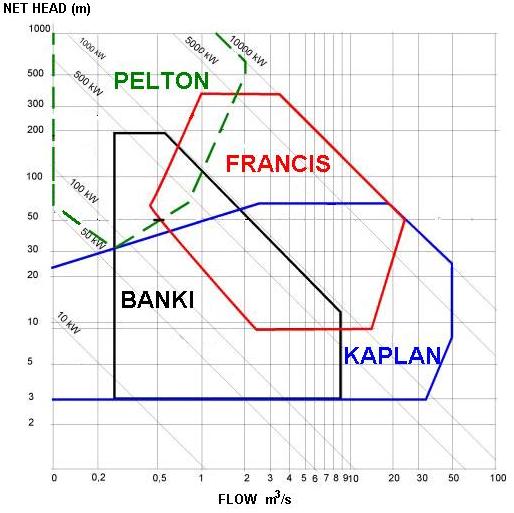
Turbine Selection
SMALL HYDRO POTENTIAL
- Decentralised, small power demand; small industry, individual farms and enterprises, rural communities.
- Low tension distribution networks and eventually sub-regional micro-grid systems.
- Individual, co-operative or communal ownership with semi-skilled labour requirements and co-operative administration.
- Short gestation period with local materials and skills applicable depending on potential, it can make a considerable impact on the quality of rural life.
- Its flexibility regarding adaptation to quick load variations makes it a favoured component in any integrated power system.
- Plants can last for very long time. Some are more than 70 years old and still in operation. Plants commissioned recently may show even longer life span and thus can serve consumers over several generations without polluting the atmosphere.
- Investment
in small hydro power have proved to be safe and secure over several decades.
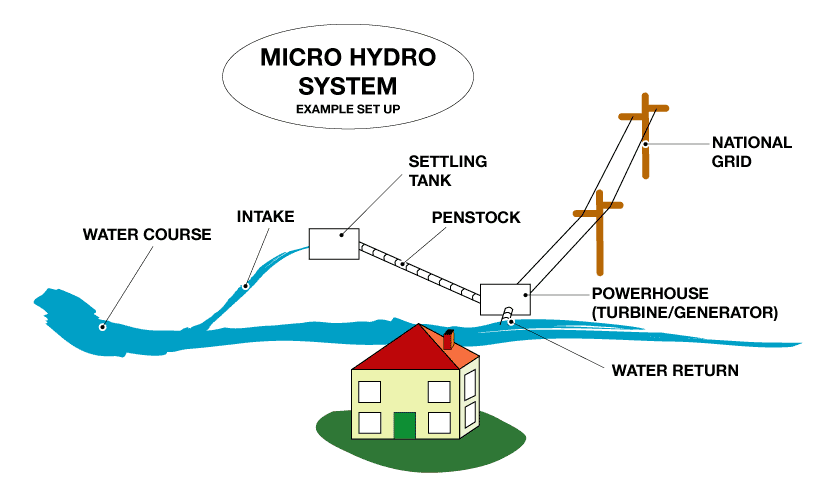
20kW.